Christmas Modern Digital Paper Patterns
If you're designing holiday invitations, launching a festive product line, or refreshing your brand’s seasonal visuals, Christmas Modern Digital Paper Patterns offer a smart, versatile foundation—especially the curated Set of 8 High Quality Modern Digital Papers from the Christmas Posters Patterns Collection. These aren’t generic clipart repeats or low-res downloads. They’re hand-painted, seamless, and built for real-world use—across print, digital, and physical products.
What Makes These Patterns Actually Useful (Not Just Pretty)
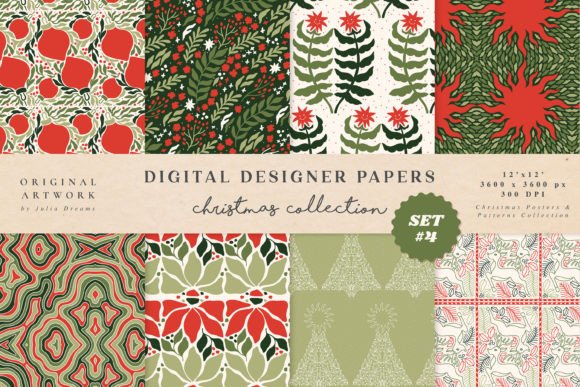
Many people assume “digital paper patterns” are only for scrapbooking or quick social posts. That’s a misconception—and it leads to underusing assets that could elevate branding, packaging, or client work. This set includes 8 hand-painted digital papers, each delivered in multiple formats: raster (.jpg and .png) for easy web use and printing, and vector (.ai, .svg, .eps) for infinite scalability without quality loss. Every pattern is sized at 12 x 12 inches / 3600 x 3600 px / 300 dpi—a professional standard that ensures crisp results whether you’re printing wrapping paper, wall art, or fabric swatches.
That versatility matters. A designer using these for wedding invites won’t need to rework resolution. A small business owner applying them to sticker sheets or planner covers won’t hit pixelation. And a blogger embedding them into newsletter headers or blog graphics won’t sacrifice load time or clarity—especially when selecting the right file type for the job.
Common Oversights—and Why They Cost Time or Money
Mistake #1: Assuming all “seamless” patterns tile perfectly across every surface. Not all seamless patterns behave the same way. Some have subtle directional cues or color shifts that become obvious on large-format prints like wallpaper or banners. With this collection, the hand-painted nature means organic variation—but it also means checking how the pattern flows at scale before committing to a full run. Test a single tile repeated in your design software at 200% zoom. If seams or repetition feel jarring, adjust spacing or add a subtle overlay texture to soften transitions.
Mistake #2: Downloading only raster files and missing vector flexibility. Beginners often grab the .jpg because it opens instantly—but later realize they need to resize for a logo background or scale up for a poster. Without the .ai or .svg, they’re stuck with blurry edges or costly redesigns. Always download all formats upfront—even if you don’t need vectors today. You’ll thank yourself when a client asks for a 48" trade show banner next December.
Mistake #3: Overlooking color mode and print readiness. RGB looks vibrant on screen—but if you’re ordering printed greeting cards or fabric, CMYK or Pantone-matched files matter. This set is RGB by default (ideal for digital use), but most design tools let you convert cleanly for print. Just remember: never convert RGB to CMYK *after* adding effects like drop shadows or glows—do it early. And if precise color matching is critical (e.g., for branded merchandise), soft-proof in your software first or request a proof from your printer.
Real-World Uses That Go Beyond the Obvious
These patterns shine where consistency and character intersect. Think beyond cards and posters:
- Branding kits: Use one pattern as a subtle background for email headers, another as a texture overlay in logo mockups—keeping visual cohesion without monotony.
- Educational materials: Teachers and course creators apply them to printable planners, lesson slides, or reward certificates—adding warmth without distraction.
- Social media templates: Layer a low-opacity pattern behind text in Canva or Figma to boost readability while keeping a festive tone.
- Product packaging: Wrap digital mockups of mugs, notebooks, or candle boxes with these papers—then export for print-ready dielines using the vector files.
One freelance graphic designer used three patterns from this set to unify a holiday campaign for a local bakery: one for Instagram stories, one for printed gift tags, and one scaled down as a watermark on recipe PDFs. Because all eight share a cohesive palette and texture language, customers recognized the brand instantly—even across platforms.
What to Check Before You Buy—or Before You Use
Before downloading or integrating these patterns, ask yourself:
- Do I understand the licensing? This set is typically for personal and commercial use—but always confirm whether attribution is required, whether resale of unaltered patterns is permitted, and whether extended licenses apply for high-volume products (e.g., selling 500+ printed notebooks).
- Are my tools compatible? While .png and .jpg open anywhere, vector files need Adobe Illustrator, Affinity Designer, or compatible SVG editors. If you’re using Canva alone, stick to raster versions—but know their limits.
- Does the color story match my audience? “Modern Christmas” doesn’t mean red-and-green clichés. This collection leans into muted rusts, deep teals, warm ochres, and creamy neutrals—ideal for minimalist, Scandinavian, or boho brands. If your audience expects bold metallics or glitter effects, these may not align.
- Is there enough contrast for text overlays? Try placing white or dark type over a sample tile. Some patterns have busy mid-tones that make legibility tricky. A 10–15% opacity overlay or slight desaturation can help—without losing charm.
A Smarter Way to Start
Instead of hunting for free patterns that lack resolution, consistency, or usage rights, begin with a purpose-built set like this one. It saves hours of editing, avoids last-minute format panic, and delivers aesthetic continuity across touchpoints. Whether you’re a hobbyist making handmade cards or a marketer building a full holiday campaign, investing in well-crafted, multi-format resources pays off—not just in time saved, but in how polished and intentional your final work feels.
The best part? You don’t need advanced skills to benefit. Open a .png in any editor, drag it in, and adjust opacity or blending mode. Want more control? Drop the .svg into a website builder or use the .ai file to recolor elements directly. These patterns meet you where you are—and grow with your needs.