Christmas Seamless Patterns: Hand-Drawn Xmas Papers for Authentic, Versatile Creative Work
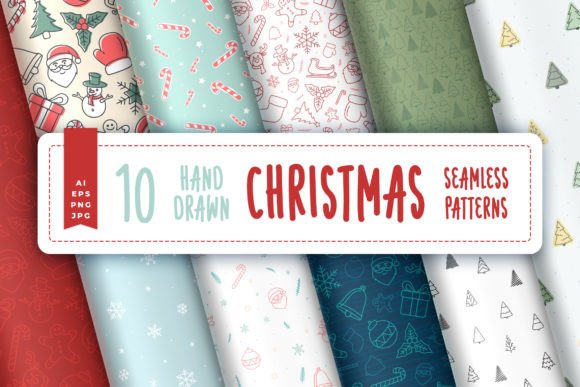
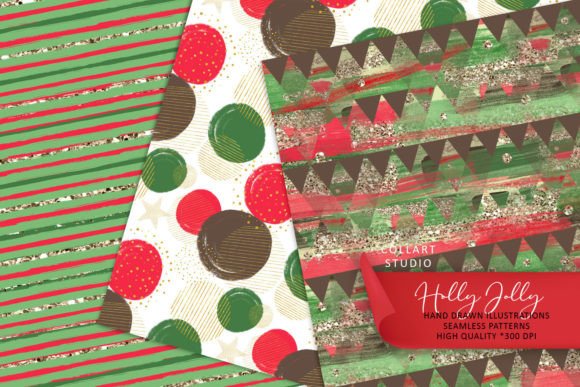
When crafting holiday-themed visuals—whether for a small business launch, classroom activity, or personal DIY project—the quality and originality of your foundational design elements matter deeply. Christmas Seamless Patterns are not just decorative backdrops; they’re functional, expressive tools rooted in tactile artistry. Unlike mass-produced digital assets, these Xmas Papers are born from ink, watercolor, and deliberate human gesture—each stroke intentionally placed by Collart Studio’s illustrators. The result is a set of three high-resolution, 12×12 inch digital papers—300 dpi, print-ready, and engineered to tile flawlessly—designed to support both aesthetic cohesion and practical flexibility across physical and digital media.
Why Seamless Matters Beyond Aesthetics
A seamless pattern repeats without visible seams or breaks—a technical necessity when scaling designs across large surfaces like wrapping paper, fabric yardage, or wall decals. But beyond function, seamlessness supports emotional continuity. A hand-drawn holly motif that flows naturally from edge to edge evokes rhythm and warmth, reinforcing the feeling of abundance and tradition central to the season. These Christmas Seamless Patterns achieve that through careful composition: each element—pine sprigs, vintage ornaments, bundled cinnamon sticks—is drawn, painted, scanned, then digitally refined to ensure alignment and balance at every repeat point. There’s no algorithmic tiling here; repetition is guided by artistic judgment, not software defaults.
This distinction becomes especially apparent in real-world applications. Consider a teacher designing printable holiday lesson cards: a non-seamless background may show jarring misalignments when duplicated across a sheet of 24 flashcards. Or a stationery designer preparing a limited-edition greeting card line—visible seams on foil-stamped envelopes would undermine perceived craftsmanship. With these Xmas Papers, scalability doesn’t compromise integrity. Zoom in, and you’ll see subtle watercolor granulation and pencil-line texture preserved at full resolution. Zoom out, and the pattern breathes evenly across any surface it occupies.
From Paper to Practice: Tangible Use Cases Across Disciplines
The versatility of these hand-drawn papers lies not only in their format but in how they integrate into diverse creative workflows. Below are concrete examples illustrating application depth—not as marketing claims, but as observed usage patterns across professional and personal contexts.
- Planner Stickers & Analog Productivity: Educators and students use scaled-down sections of the patterns to create themed weekly trackers—think a gingerbread-patterned habit grid or a snowflake-repeat border framing reflection prompts. Because the files are vector-adjacent in clarity (thanks to high-res raster fidelity), crisp cutting is achievable even at 0.75-inch dimensions on sticker paper.
- Web and Blog Design: Designers embed tiled versions as subtle CSS background images for holiday landing pages or email headers. The organic irregularity of hand-painted elements prevents visual fatigue common with overly symmetrical digital repeats—users report longer dwell times on sites using these textures as soft visual anchors.
- Scrapbooking & Memory Keeping: Unlike clip-art-heavy kits, these Xmas Papers provide tonal unity. A single paper can serve as a base layer beneath photos, while cropped details—like a single hand-painted bell or wreath—become focal embellishments. Their warmth complements printed photographs without competing for attention.
- Invitations & Printed Stationery: Wedding planners and small-event coordinators apply them as liners inside envelope flaps or as textured overlays behind calligraphed names. The 300 dpi resolution ensures clean halftone rendering when printed on luxe cotton stock—even under close inspection, the pigment variation reads as intentional artistry, not pixelation.
- Decoupage & Mixed-Media Craft: Artists scan and laser-print sections onto decoupage-safe parchment or rice paper, then adhere them to wooden ornaments or ceramic mugs. The slight translucency of watercolor layers allows underlying textures (e.g., wood grain) to show through, creating dimensional depth impossible with flat digital fills.
The Value of Hand-Drawn Originality in a Digital Age
In an era saturated with AI-generated motifs and royalty-free asset libraries, choosing one-of-a-kind hand-drawn papers signals intentionality. These Xmas Papers don’t mimic tradition—they reinterpret it. A pinecone isn’t rendered as a generic icon but as a specific specimen: slightly asymmetrical, with visible scale texture and shadow cast from a consistent light source. That specificity builds trust. When a boutique candle brand uses the same pattern across product labels, Instagram story templates, and in-store signage, customers subconsciously register consistency—not as repetition, but as authenticity.
This matters for educators building seasonal curriculum materials. Children respond more readily to illustrations that feel *made*, not mined from a database. A hand-painted star pattern used in a counting worksheet carries narrative weight—a child might notice “this star has six points, but the one next to it has five because the artist changed it”—sparking observation, conversation, and early visual literacy. Similarly, researchers studying material culture or folk aesthetics use these papers as reference artifacts: the stylization reflects contemporary interpretations of historical motifs (e.g., Victorian-era botanical engraving meets modern minimal line work), offering tangible data points about evolving visual language.
Technical Considerations for Real-World Implementation
While ease of use is built into the design, thoughtful implementation requires attention to file handling and context. Here’s what practitioners consistently find helpful:
- Color Mode Awareness: These Xmas Papers are delivered in RGB for screen use and broad compatibility—but for professional print jobs, converting to CMYK *after* placement in layout software (e.g., Adobe InDesign) yields more predictable results than pre-converting the source file. The watercolor pigments translate well to process color, especially when paired with matte or uncoated stocks that enhance texture perception.
- Scaling Without Sacrifice: Because they’re 12×12 inches at 300 dpi, shrinking them for web use (e.g., 1920×1080 backgrounds) preserves clarity, but enlarging beyond native size risks interpolation blur. For oversized applications—like 24×36 inch posters—use the pattern as a base layer and overlay hand-drawn accents (scanned sketches, physical stamps) to maintain tactile credibility.
- Layering Strategy: Designers often extract individual motifs using selection tools, then recolor or reposition them as standalone elements. This works because Collart Studio’s painting technique includes clear negative space and distinct edges—no muddy blending obscures cut-out boundaries. A single wreath, isolated and resized, becomes a cohesive watermark or corner accent without losing its hand-made character.
- Licensing Clarity: As original artworks, these papers carry standard commercial-use rights—meaning they can be embedded in client deliverables (e.g., a marketing agency using them in a retail brand’s holiday campaign). However, reselling the papers themselves—or distributing them as part of a new template pack—is prohibited. This protects both the creator’s labor and the buyer’s investment in uniqueness.
Connecting Tradition to Contemporary Making
What makes these Christmas Seamless Patterns resonate across such varied users—from researchers documenting craft revival movements to hobbyists upcycling thrift-store frames—is their grounding in process. Each paper bears evidence of making: the slight tremor in a drawn branch line, the pooling of pigment where watercolor dried unevenly, the faint graphite sketch beneath final ink. That evidence invites participation. A graphic designer doesn’t just “apply” the pattern; they respond to its rhythm. A student doesn’t just paste it into a collage—they study how the illustrator balanced density and air, then applies that principle to their own layout.
That reciprocity between artifact and user is rare in digital design resources. Most assets ask for consumption; these invite dialogue. You might rotate a section 90 degrees to discover a new rhythm in the pine needle arrangement. You might invert colors to create a wintry negative-space version for chalkboard-style signage. You might print one paper on vellum and layer it over a photo to soften contrast while adding seasonal tone—all without altering the original file.
In practice, this means longevity. These Xmas Papers aren’t tied to a trend cycle. Their strength lies in time-tested visual principles—repetition, contrast, organic variation—expressed through a singular human voice. Whether used tomorrow or five years from now, they retain relevance not because they follow algorithms, but because they honor craft.
Integrating Into Your Next Project—Thoughtfully
If you’re evaluating whether these papers suit your needs, consider not just *what* you’ll make, but *how* you’ll engage with the material. Do you prefer starting with structure (a grid, a template) and filling it—or do you begin with texture and let form emerge? These Christmas Seamless Patterns support both approaches. Their seamless nature provides reliable scaffolding; their hand-drawn imperfections invite improvisation. Click “Zoom” on any product image—not just to inspect resolution, but to study decision-making: how a stem curves, how berries cluster, how negative space functions as an active design element.
That level of detail transforms utility into insight. You’re not acquiring three backgrounds. You’re gaining three studies in seasonal visual language—each one a quiet invitation to slow down, observe closely, and make something that feels genuinely yours.