Hand Drawn Christmas Seamless Patterns: A Practical Guide for Designers and Creators
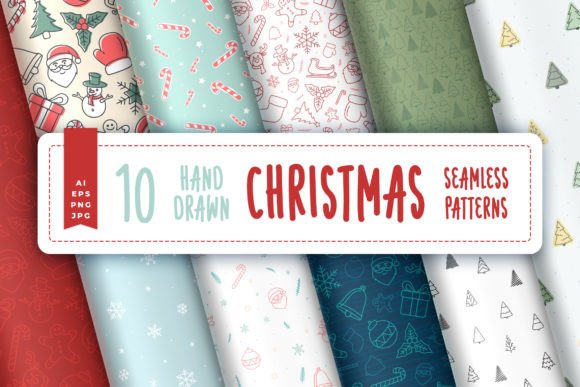
Hand drawn Christmas seamless patterns represent a distinctive intersection of artisanal charm and digital utility. Unlike mass-produced vector assets or photorealistic textures, these patterns retain the warmth, imperfection, and personality of human mark-making—while still delivering technical precision required for professional design workflows. This set—comprising 10 repeatable, hand-crafted motifs—offers more than festive decoration; it provides a flexible, production-ready foundation for projects spanning print, web, packaging, education, and small-business branding.
What Makes These Patterns “Seamless” and Why It Matters
A seamless pattern repeats infinitely in all directions without visible seams, gaps, or misaligned edges. That technical quality is non-negotiable for real-world applications: wrapping paper must tile flawlessly across a 36-inch roll; website backgrounds need to scale responsively without distortion; fabric prints require edge-to-edge continuity on bolts of material. The Hand Drawn Christmas Seamless Patterns are engineered with this constraint in mind—not as an afterthought, but as a core design principle.
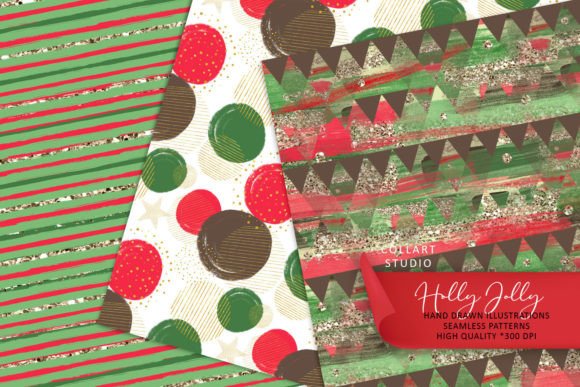
Each of the 10 patterns was constructed using deliberate spacing, balanced negative space, and intentional motif placement to ensure visual cohesion at any scale. For example, one pattern features interlocking holly sprigs with subtle stem overlaps that anchor the repeat axis; another uses staggered candy canes arranged along diagonal vectors to avoid rigid grid fatigue. These aren’t scanned sketches stretched into tiles—they’re thoughtfully composed, tested, and refined for repetition integrity.
Digital Format Flexibility Across Tools and Teams
The inclusion of four distinct file formats—AI, EPS v10, JPG, and PNG—serves practical needs across diverse software ecosystems and skill levels:
- AI files preserve full vector editability: designers can recolor individual elements, adjust stroke weights, or isolate components for custom compositions—all without pixelation.
- EPS v10 compatibility ensures backward support for legacy systems (e.g., older versions of CorelDRAW or Adobe Illustrator CS6), making the set viable in institutional environments where software updates lag.
- JPG patterns offer immediate usability in layout tools like InDesign, Canva, or PowerPoint—ideal for educators building classroom materials or marketers drafting social media templates.
- PNG files include transparent backgrounds, enabling direct layering over photos, gradients, or textured substrates—useful for product mockups, e-commerce banners, or DIY craft tutorials.
This multi-format structure reduces friction between collaborators. A graphic designer might begin in Illustrator using the AI file, then export a PNG overlay for a developer integrating the pattern into a Shopify theme background. A teacher preparing holiday lesson plans can drop the JPG directly into Google Slides without wrestling with vector imports or transparency settings.
Real-World Applications Beyond Holiday Greetings
While “Christmas” signals seasonal relevance, the versatility of hand-drawn motifs extends far beyond December calendars and greeting cards. Their organic line quality and moderate detail level lend themselves to contexts where warmth and approachability matter more than photorealism.
Consider a local bakery launching a limited-edition gingerbread cookie line. Instead of licensing generic clipart, the owner uses one of the patterns—featuring hand-sketched ornaments and ribbon loops—as a repeating background on custom kraft paper bags. The texture reads as handmade, reinforcing brand authenticity. Similarly, a university’s continuing education department might apply a subtle snowflake-and-ink-wash pattern to certificates for winter workshops—adding seasonal recognition without compromising professionalism.
In educational settings, the patterns serve dual roles: as visual scaffolding for student projects (e.g., designing holiday-themed book covers in a middle-school art class), and as teaching aids for discussing repetition, symmetry, and visual rhythm in design fundamentals. Because each motif avoids hyper-specific iconography—no branded characters or dated trends—they remain usable across age groups and cultural contexts where Christmas is observed in varied ways.
Advantages Over Algorithmic or Stock-Based Alternatives
Many designers turn first to AI-generated patterns or subscription-based stock libraries. While those options offer speed and volume, they often lack the nuanced intentionality found in curated hand-drawn sets like this one.
Algorithmically produced patterns frequently suffer from “pattern fatigue”: overly dense arrangements, inconsistent line weights, or motifs that clash tonally when repeated. Stock platforms may deliver high-resolution files, but their metadata rarely clarifies whether a pattern is truly seamless—or merely labeled as such. Users discover seam issues only after investing time in mockups or print proofs.
In contrast, the Hand Drawn Christmas Seamless Patterns were created with human judgment at every stage. Line thickness varies intentionally to suggest depth; shading is applied selectively to avoid muddying the repeat; and negative space is calibrated to prevent visual crowding at small scales (e.g., 12pt text overlays or embroidered fabric applications). That attention translates directly into reduced revision cycles and fewer production surprises.
Workflow Integration Tips for Different User Types
How users engage with these patterns depends less on technical proficiency and more on project goals and constraints. Here’s how various audiences can integrate them efficiently:
- Small business owners benefit most from the JPG and PNG files. Upload a pattern to your website builder (Squarespace, Wix) as a section background, or use it in Canva to create Instagram Stories with consistent holiday branding—no design software required.
- Print production teams should prioritize the EPS or AI files. Embed them directly into PDFs for offset printing, ensuring crisp output at any size—even on large-format banners or gift wrap rolls.
- Educators and trainers can extract individual elements from the AI files (e.g., a single hand-drawn bell or pinecone) and convert them into SVG icons for interactive whiteboard activities or accessible digital worksheets.
- UI/UX designers use the PNG variants to build lightweight, scalable CSS backgrounds (
background-image: url(...); background-repeat: repeat;). The hand-drawn aesthetic softens digital interfaces without sacrificing performance—especially compared to large photographic textures.
Design Integrity and Ethical Considerations
Using hand-drawn assets responsibly means acknowledging both their creative origin and functional limits. These patterns were made by illustrators who invested time in linework consistency, motif balance, and technical testing. Respecting that labor includes adhering to license terms—particularly regarding redistribution, resale as standalone assets, or embedding in SaaS platforms without proper extended rights.
Equally important is contextual awareness. A hand-drawn aesthetic carries connotations of craftsmanship, nostalgia, and accessibility. Deploying it in healthcare communications or financial reports may unintentionally undermine perceived authority if not paired with clear typography and data visualization. Conversely, in children’s publishing or community event materials, that same warmth builds trust and lowers cognitive load.
Also worth noting: the set avoids culturally exclusive or religiously prescriptive symbols (e.g., nativity scenes, specific denominational motifs). Instead, it leans into widely recognized secular elements—snowflakes, wreaths, stockings, wrapped gifts—making it adaptable for inclusive workplace celebrations, international retail campaigns, or multicultural school curricula.
Scaling Thoughtfully: From Pixels to Physical Output
One under-discussed strength of this collection is its adaptability across output resolutions. Vector files (AI/EPS) scale infinitely, yes—but the JPG and PNG variants were exported at high enough dimensions (typically 4000×4000 pixels or larger) to support demanding physical outputs. A PNG version of the “hand-lettered carol lyrics” pattern, for instance, holds clarity when printed at 300 DPI on a 24×36-inch poster. Meanwhile, the same file resizes gracefully for mobile app splash screens at 750×1334 pixels.
This scalability isn’t accidental. Each pattern was previewed and adjusted at multiple sizes—from thumbnail displays in asset libraries to full-bleed print layouts—to verify legibility, contrast retention, and motif readability. As a result, users don’t need to guess which format suits their end use; the set anticipates common scenarios and delivers accordingly.
Long-Term Utility Beyond Seasonal Cycles
Unlike trend-driven assets that feel dated within months, hand-drawn patterns possess enduring stylistic value. Their irregular lines, slight asymmetries, and analog texture resist rapid obsolescence. A pattern featuring ink-washed trees and uneven star clusters won’t clash with next year’s color forecast—or even next decade’s interface conventions.
That longevity supports sustainable design practices. Rather than purchasing new holiday assets annually, teams can rotate among the 10 included patterns, combine them in layered backgrounds, or recolor them to match evolving brand palettes. One user reported using the “vintage tag and twine” pattern for three consecutive holiday seasons—each time adjusting only the base hue (crimson → forest green → deep plum) while retaining all other structural qualities.
In sum, the Hand Drawn Christmas Seamless Patterns function less as disposable decoration and more as foundational visual vocabulary—flexible enough for urgent deadlines, resilient enough for long-term brand systems, and expressive enough to convey humanity in increasingly automated design landscapes.