Farmhouse Patterns Barn Quilt Pattern: A Versatile Vector Resource for Laser and Paper Crafters
The Farmhouse Patterns Barn Quilt Pattern is a carefully constructed digital design set built for precision, adaptability, and real-world fabrication. Unlike generic clipart or low-resolution graphics, this pattern delivers clean, scalable vector files optimized for laser cutting, engraving, and paper-based die-cutting workflows. Its farmhouse aesthetic—rooted in traditional quilt block geometry but simplified for modern tooling—makes it especially useful for makers who need visual cohesion across signage, wall art, home décor, and small-batch merchandise.
What You Actually Get—and Why File Format Diversity Matters
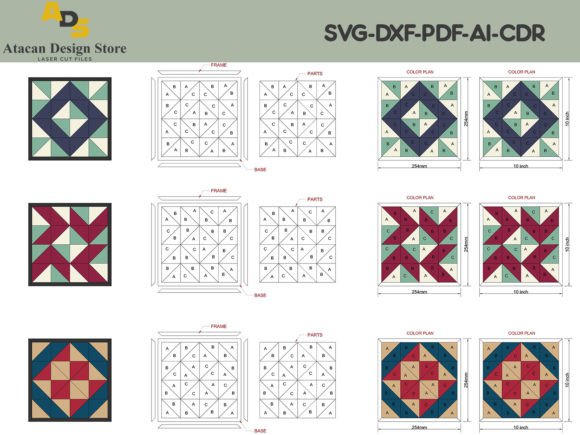
You receive five core vector formats: DXF, SVG, PDF, AI (Adobe Illustrator), and CDR (CorelDRAW), plus JPG reference files. This breadth isn’t just convenience—it’s functional necessity. A Glowforge Pro user may default to SVG for its native compatibility and layer control, while a production shop running older CNC software often relies on DXF for reliable geometry interpretation. Adobe Illustrator users benefit from editable paths and text layers in the AI file; CorelDRAW operators retain full node-editing capability in CDR. The inclusion of PDF ensures broad accessibility for proofing, layout planning, or direct import into some print-and-cut systems.
The JPGs serve strictly as visual references—not for output. They help verify scale, orientation, and motif alignment before committing to material. This distinction matters: many designers overlook how easily misaligned raster previews can lead to wasted stock or rework, especially when scaling across substrates like ¼-inch plywood, basswood, or heavy cardstock.
Real-World Performance Across Machines and Materials
Tested on a Glowforge Pro with birch plywood and balsa, the Farmhouse Patterns Barn Quilt Pattern held consistent kerf tolerance and corner fidelity at speeds ranging from 100–300 mm/s. No path duplication, no stray anchor points, and no embedded raster elements were observed—all common issues in poorly prepped SVG assets. That reliability extends beyond Glowforge: users report successful cuts on Epilog Zing, Universal Laser Systems, and Boss Laser machines without manual cleanup.
For paper craft machines, results vary slightly by platform but remain predictable. On a Cricut Maker 3, the SVG imports cleanly with auto-detection of cut lines and score lines (when included in layered versions). Silhouette Cameo 4 users confirm stable performance using the DXF import path—particularly helpful when working within Silhouette Studio Business Edition’s advanced nesting tools. Even Sizzix Big Shot Plus and Brother ScanNCut users have adapted the PDF outlines for manual tracing or registered cutting, though those workflows require more hands-on calibration.
Design Integrity and Practical Flexibility
The pattern avoids over-engineering. It uses simple geometric primitives—squares, rectangles, and quarter-circles—arranged in symmetrical barn-quilt-inspired blocks. There are no gradients, transparencies, or embedded fonts that could break during export or cause rendering inconsistencies. Stroke weights are uniform and set to “hairline” where appropriate, ensuring crisp edges regardless of scaling. All files maintain 1:1 dimensional accuracy—critical when aligning multiple panels for large wall installations or modular signage systems.
This simplicity also supports adaptation. Educators use the base layout to teach symmetry, tessellation, and coordinate geometry. Small business owners modify color fills and add branding elements in Illustrator before outputting custom barn-door signs for farm stands or agritourism venues. Freelance designers embed the motifs into larger packaging layouts or textile repeats—leveraging the vector scalability without loss of fidelity.
Who Benefits Most—and Where It Fits Naturally
Professionals in signage, retail merchandising, and boutique interior design find immediate utility in the Farmhouse Patterns Barn Quilt Pattern. Its proportions work well at both 12×12 inches (for framed wall art) and 48×48 inches (for exterior barn installations), and the clean line work translates reliably to painted wood, engraved acrylic, or embossed leather.
Hobbyists and educators appreciate the absence of proprietary dependencies. No subscription, no locked layers, no watermark. You own the files outright and can modify them freely—whether adjusting spacing for a specific jig setup or converting a single block into a stencil for chalk-paint transfers. Bloggers documenting maker projects report high engagement when sharing build logs that start with this pattern: readers recognize its versatility and often reuse the same files across multiple tutorials.
Freelancers building client-facing portfolios use the pattern as a consistent visual anchor—applying it across business cards, social media banners, and presentation decks to reinforce brand warmth and authenticity. That consistency isn’t accidental; it reflects intentional design discipline in the original asset creation.
Limitations Worth Noting—Not Dealbreakers
This is not a parametric design system. You won’t find adjustable sliders for block count, border width, or rotation angle inside the files themselves. Modifications require vector editing knowledge—though even basic familiarity with Illustrator’s Pathfinder or Inkscape’s Boolean tools is sufficient for most adjustments.
It does not include pre-colored variants or material-specific presets (e.g., “birch plywood settings for Glowforge”). Those must be configured manually based on your machine, lens, and substrate—standard practice across professional laser workflows, but worth clarifying for newer users.
There’s no multi-language support or alternate cultural interpretations baked in. The aesthetic is intentionally rooted in North American rural vernacular. That focus strengthens its coherence but means it won’t suit every global or contemporary design brief.
Making It Work in Your Workflow
Start by opening the SVG in your preferred editor and checking layer organization. Most users assign separate layers for cut paths, engrave zones, and registration marks—even if the original file doesn’t label them explicitly. Use the JPG reference to verify alignment before exporting to your machine’s native format.
If you’re batch-producing variations, consider saving modified versions with clear naming conventions: Farmhouse_Pattern_BarnQuilt_24x24_ScoreOnly.svg, for example. This prevents confusion later, especially when managing dozens of similar assets.
For paper crafters: import the PDF into your cutting software and adjust blade depth/pressure based on paper weight—not the file itself. The vectors provide geometry only; physical execution depends on your machine’s calibration and material behavior.
In short, the Farmhouse Patterns Barn Quilt Pattern earns its place in a working designer’s toolkit not through novelty, but through quiet reliability, cross-platform readiness, and thoughtful construction. It solves a narrow but frequent need—delivering authentic, scalable, production-ready geometry without hidden friction. Whether you’re prototyping a new product line, teaching a workshop, or finishing a client’s custom commission, it’s the kind of asset that stays useful long after the first cut.